Okay, so if you want to start or scale a business, then how do you know whether it's worth it to invest in a business coach or mentor or events or community? For the last 5 years, I've invested over $100,000 every single year in business coaches, mentors, and events just like this one. But it is kind of a weird thing.
Turn YouTube videos
into actionable summaries
Read and copy transcripts, generate AI summaries and save them in your Library. All in one Chrome extension.
0:0020:52
The Business Advice You Won't Find on YouTube
Sprints
Source: YouTube
Like, firstly, why would you pay for business advice when it's all freely available on YouTube or on ChatGPT? And secondly, how should someone think about an investment that has absolutely no guarantee of you actually being able to make your money back?
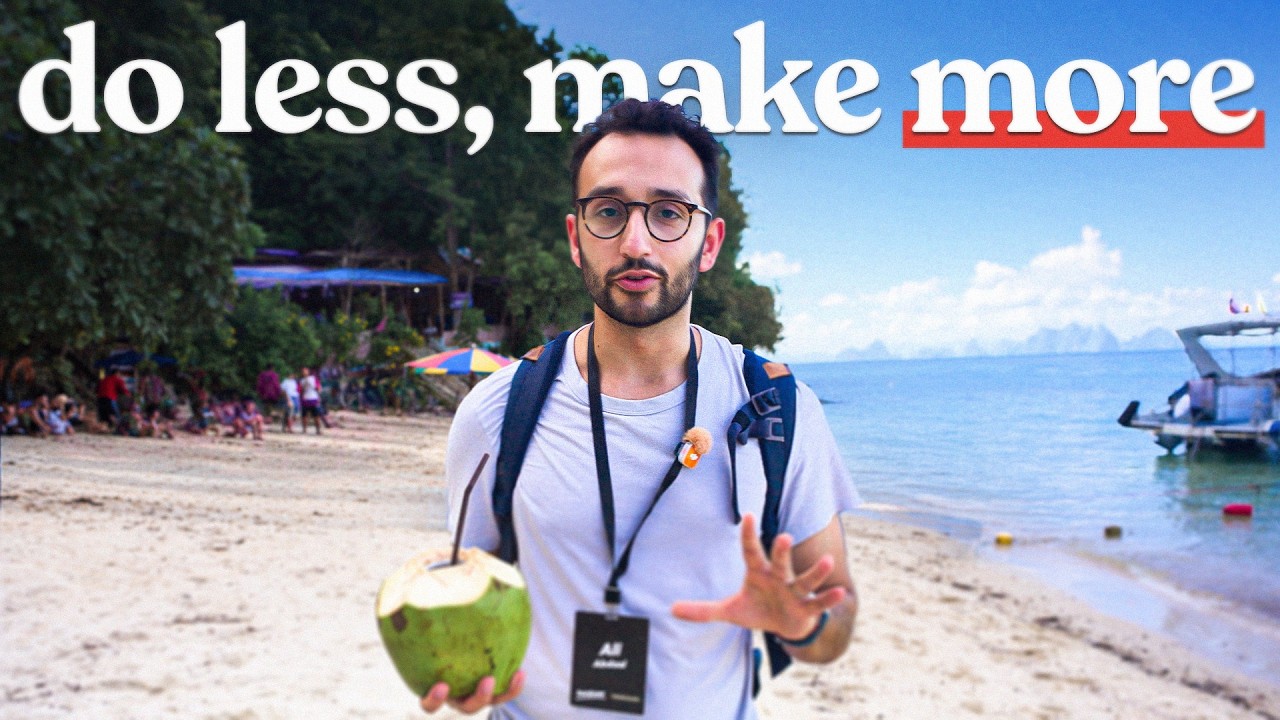
And so, right now we are in Thailand for a entrepreneur event hosted by one of my mentors, Taki Moore. And so, in today's vlog, I want to show you what goes on in an entrepreneur event like this one.
And then, maybe towards the end of the vlog, we'll decide together uh was this actually worth it in terms of the return on investment. All righty, so we have just wrapped day one in the morning. We got [music] these cute little notebooks, and we got these worksheet type things.
We had a few hours of sessions this morning. We kind of wrote down what are our wins in the business over the last few months uh and what are our goals for the next 4 months until the next uh one of these events, which is happening in Austin, I believe, in November.
And we were identifying what are the core areas of our business that we want to focus on. So, we've got like a focusing lens with which to approach the rest of this 4-5 day event.
But one idea I really vibe with is, you know, with [music] Alex Hormozi's book, 100M Offers, its whole schtick is how do you create an offer so good that people feel stupid saying no to it.
of the chat so far has been that instead of worrying so much about the offer, which, you know, of course it's important to get people into the gate, but once you've got people in [music] your product, how do you make your product so good that people would feel dumb to leave your product?
[music] And that I think is now the North Star of our Life School Business Academy. Like, we've got a really good offer.
And the thing we want to do now is build the world's best online business school, where if someone is in the academy and in like in the community, they never want to leave because the product is that good and the experience they're having is that incredible.
Of course, you can get a lot of free business advice off of ChatGPT. But the problem with ChatGPT is that ChatGPT gives you very generic advice. And you can certainly read lots of business books. That's how I got most of my business knowledge.
It was reading books and then applying those insights to my own business and then learning from that and the whole shebang.
And of course, you can totally listen to podcasts where people are talking about this stuff and of course, you can watch the YouTube channels where people are sharing tips on how to make a good offer or how to make a good product and all of these sorts of things.
But what you don't get with that kind of generic advice is specific [music] insight for your specific situation. Like if for example, you're trying to figure out like what business idea to pursue. Um sure, you can ask ChatGPT generally what are the characteristics of a good business idea.
You can certainly read some [music] books about it. You can watch some YouTube videos about it. But it's very unlikely that those resources will give you a sense of does this [music] business idea make sense for you given your own personality and passions and background and skills and experience and expertise.
Whereas [music] if for example, you pay for a business coach or a business mentor or you attend a business event where you're just talking to people cuz you know, quite a lot of these business events are actually totally free. There are probably some in your local city.
And you're speaking to people who have maybe even done that business idea, then they can tell you, be like, "Hey man, >> [music] >> I know you're thinking about doing X.
I've been in the industry for 10 years and I've seen from my own experience or the experience of other people like, you know, these are all the different ways in which business idea X actually works versus it doesn't work.
And what [music] a business coach, mentor or someone who's actually done the thing before will give you that ChatGPT won't is that they will actually be able to push back on your stuff to hopefully [music] save you a bunch of time.
And for me, it was only when I started to see business and making money in general as a skill and a skill [music] can be learnt just like anything else.
And there are some people out there who are better than me at the skill as evidenced by the fact they are making more money than I am in my business and [music] have been doing this for a way longer time.
Why wouldn't I pay in terms of money and time and energy to attend the events where these people hang out or like sign up to a business coach or a business mentor. There's a nice phrase I heard recently which is that you always end up paying for learning.
Either you pay with money where you learn from the experiences of other people or you pay with time where you are trying to figure this stuff out by yourself. But yeah, that was the morning session. Let's now get on with the rest of the day. >> [music] [music] >> All right, gang. It is currently 1:00 p.m.
and we are on our way to the moving mastermind. Now, the way a mastermind works is that basically they've split us all into groups of six, [music] and each person has about 10 minutes to bring their most pressing business challenge to the group.
And then, you got 10 minutes for the group to give you advice and input on what your specific [music] challenge is. This one is a moving mastermind, is what they're calling it, where we are going to be doing it on boats, just [music] you know, change up the scenery a little bit.
And the last version of this that we went to was actually in California, and we were masterminding on hot air balloons. So, that was quite vibey and fun.
At the time, the challenge that we were facing with the Lifestyle Business Academy was we were just getting it off the ground, [music] and so we had loads of issues with our curriculum and our product and things.
But then, we fixed all of those issues, and now the challenges [music] that we're facing are more about like problems of scale rather than problems of of kickstarting the product and getting it off the ground. So, yeah, we got everyone on the bus over here, and yeah, next [music] stop, the moving mastermind. Let's go.
>> [music] >> So, um, we have a Baby Tuddles online business school program that helps a normal person start a coaching consulting or service business to get to their first [music] $10,000. It's not 10K a month, it's actually the first $10,000. Yeah.
That's our 6-month incubator, and then our Ascend is our 12-month accelerator that helps them go from 10K to uh, 10K a month. >> [music] >> All right, so we have just wrapped up our moving mastermind. It is now 4:00 p.m. on day number one. Uh, that was great.
I got a bunch of very useful advice about um, various areas that we are working on for our Lifestyle Business Academy and also for our team. So, uh, my original question was about how do we make our Lifestyle Business Academy so valuable that people are delighted to stay with us for years rather than just months?
Um and then there was another question around uh how do we help our coaches [music] uh basically coach our students better and spend less time doing admin and billing and this sort of stuff and so got some good ideas there.
And then we had a great chat about team values where Rachel and Shay shared their experience of building like teams of 100 plus people and how to figure out what the values are of each individual team member and how they align to the values of the business which I found insanely helpful as well.
So overall, man, that was great. >> By the way, quick word from the sponsor of this video, which is Stan, who me and my team are huge fans of. It is a service that we recommend to all of our students in our Lifestyle Business Academy, especially when they are setting up their very first online business.
And actually a lot of our students using Stan have made hundreds and thousands and even tens of thousands of dollars online from their very first business, because Stan makes it super easy to get started with selling stuff online, whether you're selling a digital product or a PDF or an online course or one-on-one coaching calls.
They do all of that in a super simple platform that means you can actually focus on the work of your business rather than dealing with the ins and outs of trying to code your own platform. Now, Stan has a bunch of features that help you increase the amount of revenue you're making from your online business.
Firstly, they have order bumps, where if someone is buying one thing, then at the bottom of the page you offer them the option of buying additional things. And this is very good because it can increase your average order value. And then the second thing that Stan has is funnels built in.
So if someone buys something, on the following page you can offer them the upgrade to that thing. And if they say yes, amazing. And if they say no, thank you, that's okay, you could offer them something smaller instead.
Like for example, someone might buy your first product for $47 and then maybe they tick the box for the additional workbook that you're offering.
And maybe they say no, thank you to the big upgrade, but they say yes, please to the smaller upgrade, which means that one order is now worth, for example, $93 rather than $47. And that's basically like finding a whole second customer, except you didn't actually have to go out and find a whole second customer.
What's cool is that Stan doesn't take any cut of your sales, it's just a simple monthly subscription. And so the more stuff you sell, the better the deal gets.
If you want to give it a go, there'll be a free trial link down below to a 30-day free trial of Creator Pro, which has all of the funnels and the order bumps and stuff built in. So, thank you, Stan, for sponsoring the video, and let's get back to it. >> [music] [music] [music] >> All righty, we are at 4:30 p.m.
and it's actually day three. I didn't do any vlogging yesterday. I intended to, but then it was super busy and I had other things to do in terms of all of the other conversations and stuff that were happening. Day two was pretty sick.
The morning actually started off a bit weird because our daughter, who is here with us, she's got diarrhea and so got a bit dehydrated during the night. So, we had to source some electrolytes. We took her to a local hospital clinic type place. They checked her out and she sort of revived with some electrolytes.
So, that was sick. >> [music] >> Um so, I missed the morning session, which was Maria Wentz's talk, but I'm going to catch the recording of it cuz these guys record the sessions, so that'll be that'll be handy.
But then, I was giving a talk about YouTube and about YouTube systems, talking about how I think about content creation, how we coach business owners to think about content creation, and basically giving permission to the coaches in the room to like be okay with making content on YouTube [music] cuz they already have expertise.
Like everyone here is a coach or an online educator to some degree. And so, it's a very small step from doing that over Zoom to doing that on YouTube videos. And I think a lot of people really overthink the having to do YouTube as a YouTuber.
And increasingly, especially with the algorithm the way it is, it's it's actually it's a lot less about trying to build a big following and more about just making videos that uh address the pain points that your existing clients have, if you're a business owner.
And so, you already know how to talk about those pain points. And so, you know, we talked about that a lot. It was a Q&A session. It was good vibes. But then, straight after that, we went to do a podcast with Maria Wentz. That was super fun. >> Okay, I have I have a bone to pick with you.
>> [music] >> You've Oh my already. >> we should just start with that. >> Let's just start with that. >> understanding Okay, here's the thing, right? You know, you know, broadly, revenue equals price multiplied by volume, shall we say? >> Yes. >> So, if you want to make $100,000, you could sell one thing for 100 grand.
>> Yes. >> Or 10 things for 10 grand. >> Yes. >> Or 10,000 things for $10. >> Mhm. >> And I feel like your whole vibe is the sell 10,000 things for $10. >> Yes. >> Which goes counter to almost all conventional wisdom. >> Yes.
>> Including my view on this, which is that it's actually easier to sell 10 things for 10 grand. >> Yes. >> And it's to sell 10,000 things for $10. >> Yes. [music] >> So, can you help me understand what's going on here? >> That is such a great question, and I do think that it's easier to sell 10,000 things at $10.
So, [music] I I stand by what I think. >> Oh, so you think it actually is easier? >> I think it is literally easier to sell 10,000 things at $10. [music] >> Yeah. And Maria makes about 10 million dollars a year uh selling very cheap things. So, she's selling insane volumes of very cheap things.
Uh which kind of goes counter to the traditional wisdom that I could believe, which is that it's actually easier to make a lot of money by selling small numbers of expensive things rather than large volumes of cheap things. But, I felt like Maria made a pretty good case for the low-ticket business model.
And so, maybe I'm beginning to change my mind about the value of low-ticket stuff. All righty. So, it's day three. We've just wrapped up the morning. It is now the morning break. Absolutely sick workshop from this guy, Jason Fladlien, about webinars and how to do a really really good webinar.
And I had like so many like grain wave moments and like insights and stuff throughout the whole thing. And I was like, "Damn it." It's one of the situations where like I I I I've been doing like webinars where sort of we do a workshop and then we sell something at the end of the workshop.
I've been doing that for a few years. But, I'm just sort of kicking myself in that I've never actually taken the structure of those seriously. And so, seeing like this guy who's been doing this for like 20 years and has consulted with like Alex Hormozi and Tony Robbins and people like that.
And the big insight from this talk was that like, "Woah, if we had this method that he just taught us of doing workshops and doing webinars, man, we would have way more students in our products who uh whose lives will be changed by the products.
We've done workshops that sell couple hundred thousand dollars worth of things. This guy has done workshops that have sold ten million dollars worth of things on a single event or on a single workshop. And the only difference is the level skills. And skills can be learned. And this guy's out here teaching the skills.
I'm like, great. So now we've got a session with the same guy where we're going to be explicitly working on our own webinars and I've got a bunch of questions that I want to ask him as well. And so yeah, absolutely sick stuff. >> [music] >> All right, now it is 4:30 p.m. Man, today has been absolutely insane.
So we had the webinar thing in the morning and then we had Jason the webinar guy do another like uh sort of smaller group Q&A.
And then we had a session with Taki that he called the reducer and the whole idea behind the session was inspired by Rick Rubin uh the famous music producer who wrote on one of his or writes on one of on his albums reduced by Rick Rubin rather than produced by Rick Rubin.
As a business grows, it starts to feel very heavy. And the default thing that most people do is they add stuff. It's like, how do we make more money? Well, we add new products. We add new clients. How do we make our clients happier? Well, we add new features and add new stuff.
But what that results in is a business that is often overwhelming for the founder and the team and also often a business that's overwhelming for the clients themselves.
And so this session was a sort of strategic look using like posted notes and talking to people in the room who have experience with this stuff around what are the things you could potentially delete from your business to make the whole thing a little bit more lean and effective and efficient uh rather than just thinking of add add add cuz the danger with coming to an event like this is that you get all these different ideas and then you want to add them all to your business and then the business becomes even heavier.
And so there really is a skill in deciding what are the small number of things we are going to surgically add or remove from our business without just adding loads of stuff wholesale. Then we had a lovely lunchtime session with an amazing chap called Simon.
Simon worked in like corporate enterprises his whole life, like led sales teams, etc., etc. And then he started his own consulting business.
Um and what he does now is that he consults with business small and big businesses and helps them codify their intellectual property into a kind of visual model, a visual mental model, shall we say, uh of what their process is. I've known of Simon for a year.
We sort of sort of spoken a little bit on and off at these events like the last two times, but we've never really sat down and had a proper conversation. And it's always been on my bucket list that I need to talk to Simon about this like models stuff.
And especially in our case with our Lifestyle Business Academy where we're trying to help complete beginners start their first business and then get to their first sale, then get to $10,000, then get to 100K a year, and then eventually get to a million a year. We're not going to worry about the 100K to million.
We're just focusing on the first 100K for now. And there is so much stuff. Um so many skills and so much like curriculum that goes into that.
And we've done I've done my best to sort of simplify into a model that makes sense in my mind, but I think working with a professional um who specializes in this sort of stuff to sort of pull more insights and wisdom and stuff out of me um would be really helpful in constructing a better model that our students can then follow to make to demystify even more of the journey of starting a business completely from scratch and getting it to six figures of revenue and beyond.
And so that conversation I think we started it around like 1:00 p.m. and it finished We finished like 4:00 p.m. It was like 3 hours long. Now at the start of this video we talked about this question of like why would you pay for stuff like this when you can get stuff for free on ChatGPT?
And yesterday or the day before we talked about the personalization nature of it.
The thing I wanted to talk about today is the networking is like a a a bit of a dirty word, but like every single time I go to like a business event, just being surrounded by other people who are all doing the same thing and you're able to speak the same language and able to resonate with exactly the same problems and all the same challenges and have similar goals, it's so cool to be part of a community like that.
And there's a bunch of people I've met at this specific event over the last year and also similar business events, who've then actually become friends where we hang out outside of business events, and they come and stay at my place in Hong Kong, and we go stay stay with them when we're visiting their country, or like we go on holiday together, and it's so sick to have this sort of global network of friends who are all doing similar things, and all are in the same boat of like wanting to help each other out.
When you get the right group of people, you don't think of each other as competition, you just think of each other as friends, collaborators, colleagues, and everyone is trying to help each other out, and that is amazing.
There's a lot of wisdom that's shared amongst the group, which again, you just can't get with ChatGPT. So, the whole thing of like, all the information's free on the internet.
Well, there's one thing is like it's not it's not personalized to you, it's like the average the average information is free on the internet, but also, all all the information is actually not on the internet.
Once you start to get out of like the complete beginner circles, the way you actually acquire business knowledge and skills and strategy is by talking to other people who are doing the thing.
It is not by trying to research off of the internet, because generally the people at the highest levels of doing a thing are not talking about it on the internet.
They are generally sharing it in closed group circles, because they either have no intention to talk about it about it on the internet, unless they're literally a business coach.
In a way, this is why it seems like when it whenever you look for business advice in particular on the internet, it seems like well like the only people that give business advice are people who are trying to sell you a business course. This is one of the reasons why I'm doing this.
Like, if I was a guitar teacher, there would be no reason for me to vlog my experience at a business conference where I'm learning strategies and tools to grow my guitar coaching business, because my audience is guitar players. Like, why do why would they care about me sharing advice on how to grow a guitar business.
But, in my case, it's a bit meta because, you know, we're helping people start businesses, and so me giving you an insight into what it's like to be at a business conference um might give you some inspiration to start your own business, cuz that's aligned with the with the stuff that we sell.
There's someone here who coaches farmers on how to become better farmers. There's someone here who coaches magicians on how to become better magicians and how to like get more gigs. There is someone here who coaches mechanic auto repair shop owners in Australia on how to run a better auto mechanic repair shop.
None of these people are out there on the internet talking about how to grow a business because their target audience does not particularly care.
It can seem from the outside that like all this advice is on the internet and once you're in the world and you realize you realize how generic and non-personalized and often how missing most advice on the internet actually is from the real stuff on the ground. So that's another reason to come to an event like this.
So, we are here on day four and we are canoeing or being rather we are being canoed through some islands. It's It's pretty sick. What do you reckon Isabella? >> Yeah, it's been really nice. Good vibes. And a good way to end the and the week.
>> Yeah, so the way that this event works is that the first three days I'm with everyone and then the fourth day is just for the boardroom people.
And the boardroom is if you've got a business doing at least a million a year and so yeah, smaller group, good vibes and [music] we're hoping to yeah, hoping to learn some stuff and even if we don't just have a good have a good time. >> [music] [music] >> Oh, alrighty. It's day four of four. We've just wrapped.
Today has been absolutely wild. There was a boat party. We went for a little canoe trip. We got canoed around like the caves and things. Went back on the boat, had some lunch, had some great conversations, good vibes all around. [music] So that brings us to the end of this four-day trip.
And so the final question that I want to attempt to talk through is was this worth it? So for context, this is a group that we are part of. You got to pay 60,000 US dollars per year to be part of the group.
And to be honest, I don't really use the features of the group very much except the three events that they do every year. And so in a way, you could say that [music] each of the three events costs us $20,000 to attend. And so the question I'm asking myself is was this worth 20 grand?
The answer is hell yes, like by an absolute mile. Even just like on day one in one of the sessions that Angus, one of our team members, had over lunch with some of one of the other guys, we got an idea that will immediately add way more than $20,000 of value to the business. So, it was ROI positive on day one.
And then in addition to [music] that, made some really cool connections. Going to be working hopefully we're working with Simon to figure out our genius model. Made friends with this cool guy Jason who specializes in webinars and he had a great session about the webinar stuff and so he and I connected now.
And so next time we do a webinar it's going to be it's going to be so much better.
And also then and now I've got his WhatsApp and so I can message him and be like, "Hey Jason, can you help us out with some stuff?" So, yeah, so in terms of just tangible ROI for the business, there's just absolutely no doubt in my mind that this was well worth the money.
When I go to entrepreneur events like this where everyone is at a similar stage in their business, we're all going through the same challenges. It's just you just you just speak the same language as them and it's absolutely exhilarating to just have a conversation with anyone and finding out about their business.
So, yeah, totally worth it. And if you are at this point in the video, I hope this has been vaguely useful for your journey in some way. And if you are at this point in the video, I would love to know in what way has watching this far in this video actually been useful for you and your journey.
I make these videos not for fun but because I want them to be useful. It is also fun but it is much more fun [music] when me and my team get a sense that the stuff that we're making is actually useful. Um so, I'd love to know if this has been useful in any way.
If you are interested in learning what it takes to build a business so that you eventually get invited to give talks and attend events like this one and there is a video right over here which talks about [music] kind of the grand plan that I would follow if I was starting a business from scratch and I was trying to grow it to six figures a year in revenue ideally within 12 to 18 months.
So, that'll be right over here. Thank [music] you so much and see you in the next video. Bye-bye.
Instantly understand any YouTube video
Get the key ideas in a clear AI summary. Source excerpts and timestamps keep the original video in reach.
Sprints
Customizable YouTube summaries
Choose a format and language, or add your own instructions to focus the summary on what you want to learn.
Transcribe YouTube videos without captions
Sprints Pro creates a transcript for public videos without captions. Turn it into a summary, copy the text or send it to your favorite AI tool.
Sprints
you always end up paying for learning.
Either you pay with money where you learn from the experiences of other people
or you pay with time where you are trying to figure this stuff out by yourself.
But yeah, that was the morning session. Let's now get on with the rest of the day.
Hand it off to your favorite AI tool
Send the transcript to ChatGPT, Claude or Gemini with a ready-to-use prompt. Ask follow-up questions, explore an idea or turn the video into something useful.
And much more!
Save and organize summaries
Save summaries to your Library. Find them across devices, revisit versions and export them.
Choose a language
Choose from the video’s available caption languages and pick the language for your summary.
Copy transcripts
Copy a clean transcript in one click. Paste it into your notes, a document or your next conversation.
Jump to timestamps
Click a timestamp to revisit the part that matters without searching through the video.
Pricing
Start free. Upgrade for more summaries and AI transcription.
Free
Transcripts and AI handoff.
$0forever
- Read YouTube transcripts
- Jump to any timestamp
- Copy clean transcripts
- Use with ChatGPT, Claude or Gemini
- Choose a popup or sidebar view
- 10 free AI summaries to try
Pro
AI summaries and transcription.
$6.99/ month
- Everything in Free
- No separate AI subscription needed
- 100 AI summaries per month
- Source excerpts and timestamps
- Access your Library across devices
- Custom summary styles and exports
- 200 AI transcription minutes per month
Compare plans
| The details | Free | Pro |
|---|---|---|
| Transcripts, timestamps & copying | Unlimited | Unlimited |
| Send to ChatGPT, Claude & Gemini | Unlimited | Unlimited |
| AI summaries | 10 to try | 100 per month |
| Read, export & delete your saved Library | Included | Included |
| Transcription without YouTube captions | — | 200 minutes per month; up to 120 minutes per video |
Frequently asked questions
How do I copy YouTube transcriptions?
Open a YouTube video and go to Transcript in Sprints. Click Copy transcript, then paste the text into your notes, a document or an AI chat.
How do I summarize YouTube videos?
Open a video, go to Summary in Sprints and choose your summary style. Generate a summary to get the key ideas with source timestamps, saved in your Library.
Is Sprints free to use?
Yes. Existing transcriptions already provided by YouTube will always be free. You can also hand the transcriptions off to your favorite AI tool for free, no limits included.
Upgrade to Pro to generate transcriptions when YouTube doesn't provide them, or to unlock AI summaries.
Does it work with every video?
Sprints reads creator-provided and automatic captions. Pro also adds AI transcription for public videos without captions, up to 120 minutes long. Private, unlisted, live and restricted videos are not supported for AI transcription.
How do I send YouTube transcripts to ChatGPT, Claude, or Gemini?
Open Transcript in Sprints and choose ChatGPT, Claude or Gemini under Send to. Sprints prepares a prompt with the transcript and opens your chosen tool. Review or edit the prompt, then send it when you're ready.

Good videos deservemore than a closed tab
Transcripts and summaries, right beside the video.